

A King's High or Royal Crush?
- Jul 8
- 3 min read
Updated: Jul 11
Riding the Tidal Swings of Ultimate Texas Hold ‘Em

In 2026, poker junkies needn’t sink into an eight-foot plywood table or pursue World Series hysteria to find their fix of flushes and straights.
It may just be as accessible as surfing the 24-hour premises of that wavy, unpredictable gaming floor.
Philosophical guru Bodhi (Patrick Swayze) once preached in 1991’s Point Break that experiencing the “ultimate ride” of your earthly desires may require paying “the ultimate price.”
Well, the perils of Ultimate Texas Hold ‘Em are hardly as treacherous as those hundred-foot breaks of Australia’s Bells Beach that turned the bank-robbing surfer into fish food.

Yet, questions abound when it comes to this riveting brand of poker, a game in which your fortunes can waver dramatically from one card to the next.
Straight up, Ultimate Texas Hold ‘Em pits you against one nemesis (the dealer) and not a half dozen guys assessing your eye contractions and facial twitches.
Here, your main adversary is the game itself – and knowing how to strategically utilize its various features and allowances while sidestepping the subtle little hazards.
After laying down the mandatory Ante and Blind wagers, the dealer tosses you a pair of Hole cards. As in traditional Hold ‘Em, these cards will be combined with the five community cards (three-card flop, turn, and river) that are later revealed throughout the game.
However, the key to UTHE is the Play circle positioned on the felt furthermost toward you, the player. It is here where you drop your raise wager at one of three times – before the flop, after the flop, or after the turn and river cards.
Of course, a fourth option also exists – the fold, which comes after the river but before the dealer reveals his/her Hole cards.
Once a Play bet is performed, it becomes a one-and-done affair. You cannot re-raise on your initial Play wager. That’s why the timing in which your Play bet is executed becomes the most critical part of the Texas Hold ‘Em experience. The further the game progresses, the less currency you’re permitted to drop onto the Play dot. Hence, the less you’ll rake in on a monster hand.
For instance, after your Hole cards are flipped, you may raise either three or four times the amount you dropped onto the Ante dot. It’s a power move where most UTHE fanatics find either fruition or failure.
Pundits advise the triple or quadruple raise if your Hole cards are showing a pair or Ace-high.
If you wisely check after the Hole cards are issued, the three flop cards may significantly change your outlook. In these cases (perhaps a pair or better), you’re permitted to drop twice (2x) your Ante bet onto the Play circle.
A second check allows you to view the turn and river cards, at which point your Play bet would equal your initial Ante bet (x1). If your hand remains a stinker, you can withhold action on the Play bet and wisely opt for a fold. Under this scenario, you’d relinquish your Ante and Blind bets, as well as your optional Trips wager.
Mind you, dealers must qualify with at least a pair, which includes the spread of the five community cards. Otherwise, your Ante wager becomes moot (a push) while your Blind, Play and optional Trips wagers remain fair game.
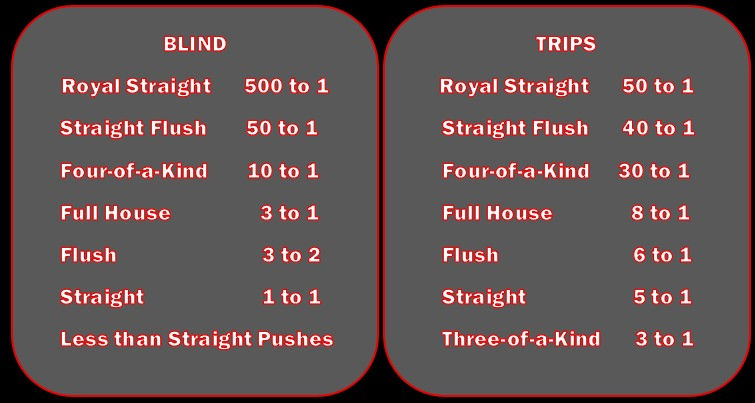
The required Blind bet is perhaps your most glaring pitfall of all – and the House’s greatest ally (Note: The House savors a roughly 2.2% advantage). It only profits when your hand reflects a straight or better. Yes, a three-of-a-kind (or anything less) becomes a mere push, provided your hand topples the dealer’s.
If the dealer hand bests yours, the Blind wager becomes an official loss, regardless of how stellar your hand may be. Even if your Blind play strikes, the payouts are modest at best (landing a straight is merely a x1 profit).
A far rosier deal is the Trips option, which generously dishes you a x3 payout on a three-of-a-kind (regardless of win/loss result) and as much as x30 on a four-of-a-kind score.
Before dabbling with UTHE, remember to anchor down with a hefty bankroll to ensure you can cover the x3 or x4 raise during the initial Hole card deal.
Otherwise, you could be set adrift with no chance of maximizing your take.
UTHE is ultimately an exhilarating dive into table-based gaming where your fortune can sink or swim as rapidly as an ocean current.
As such, we at chipster found our UTHE run more thrilling (and lucrative) than our turn with Pai Gow and 3-card poker, and at times, served up one-hundred percent pure adrenaline.


